Housesteads
Roman name: Vercovicium- Managed by
- English Heritage / National Trust
- Nearest stage
- Stage 3, on the Whin Sill
- Getting there
- On-trail; 122 bus route
- Built
- c. AD 124
01 The garrison fort
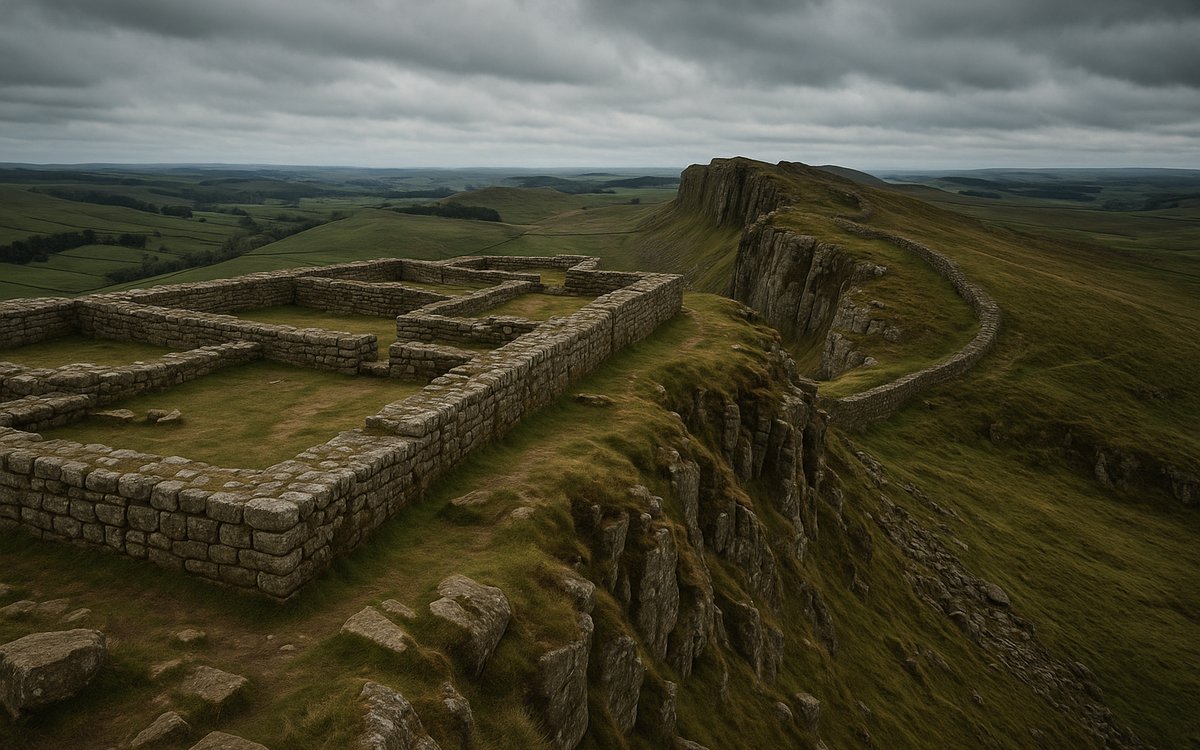
Housesteads (Vercovicium) is the most complete Roman fort in Britain, built around AD 124 to hold roughly 1,000 troops and remaining in use into the 4th century. Its best-known single structure is the communal stone latrine in the fort's south-east corner — considered the best-preserved Roman latrine anywhere in the former empire, complete with the stone channel that once carried flushing water collected from a rainwater tank nearby. Surviving joist-holes show the original seats were wooden; an actual wooden latrine seat, remarkably, was later found at nearby Vindolanda.
02 The Tungrian garrison
From the late 2nd century into the 4th, Housesteads was held by the First Cohort of Tungrians — originally raised around Tongeren in modern Belgium — reinforced later by a unit of Frisian irregulars from what's now north-east Holland; the Notitia Dignitatum still records the Tungrians in place in the 4th century, right up to the end of formal Roman Britain.
03 Visiting
Housesteads is on the trail itself (Stage 3) and on the 122 bus route; the fort's own car park and visitor centre sit a short, steep walk below the fort on the escarpment.
04 The vicus outside the walls
A civilian settlement, or vicus, grew up along the road south of the fort — traders, families, and camp followers rather than soldiers — and its stone foundations are still traceable on the ground today. Excavation suggests it was abandoned around AD 270, decades before the fort itself.
05 The setting
Housesteads sits directly on top of the Whin Sill escarpment, the trail's most dramatic stretch, with the fort's north wall forming a sheer cliff edge — among the reasons it's the single most-visited fort on the whole wall.